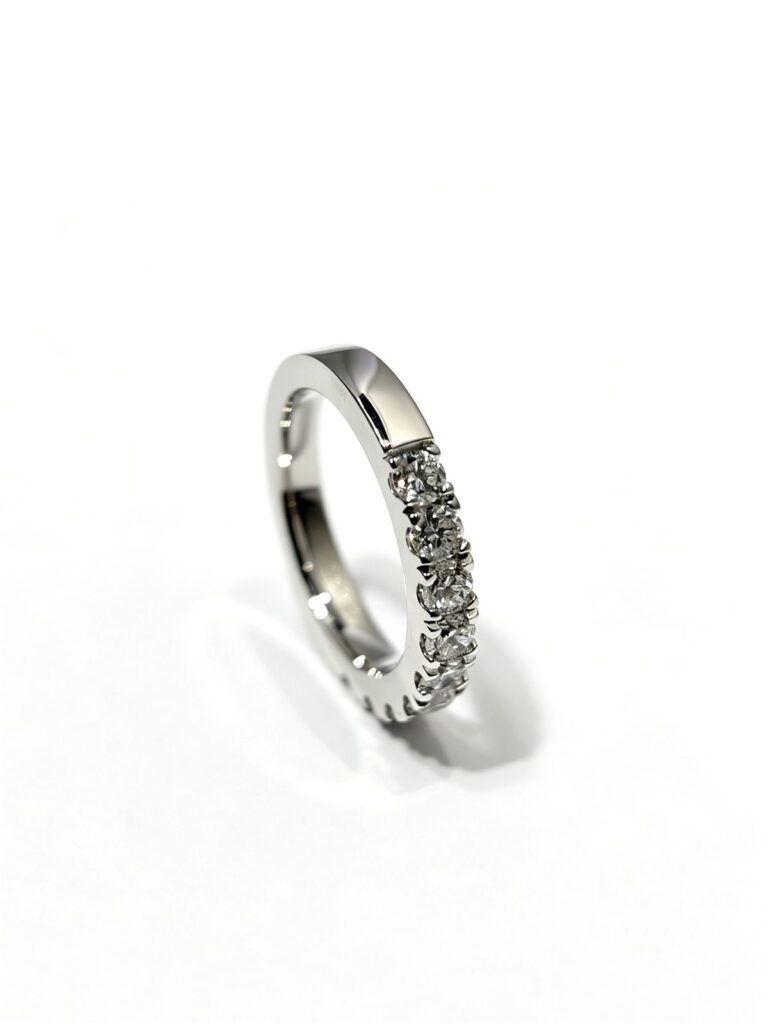
Is a piece with many small diamonds better value than one larger stone?
925 sterling silver jewellery, set with lab grown diamonds and made in our own Shenzhen workshop.
Talk · Buying & value
A buyer compares two silver rings: one with a single 0.50 ct lab-grown diamond and one with a pave of many small stones totalling 0.75 ct. The pave ring is cheaper. They want to know whether it is better value.
 ZKZ Editorial TeamMain answer · Product & gemmology desk
It depends on what you value. A ring with many small diamonds can look larger and sparkle more for the same budget, but its total weight is split into tiny stones that are normally not graded one by one. A single larger stone is easier to grade, check and compare, and larger stones are normally priced higher per carat than small ones. Compare the look, the quality information and the durability, not just the total carat weight.
What the numbers mean
Fact GIA explains that "carat weight" applies to an individual stone, such as a centre stone, while total carat weight (tcw) is the combined weight of all the diamonds in a piece. It says a ring with many small diamonds totalling 2.50 carats can cost significantly less than a solitaire of 2.50 carats, because larger diamonds are rarer than smaller ones of comparable quality and so cost more per carat.
Fact GIA also says melee diamonds are sold in large parcels, sorted by colour and clarity, and that individual grading reports are not expected for them because grading each one is not practical.
Our advice So a headline weight of 0.75 ct made of many small stones is not directly comparable with a single 0.50 ct stone. The first gives more total weight, and the second gives one stone you can see, measure and, if it has one, check against a report.
Where small stones win
- Sparkle and coverage. Pave and halo designs create a field of light.
- Look of size. A cluster can make a ring look bigger than its centre stone.
- Price per piece. The total cost is often lower.
Where one larger stone wins
- Clarity of what you own. One stone can have its own report.
- Simplicity. There are fewer parts to check and to lose.
- Resale and repair. A single stone is easy to match or replace.
- Maintenance. Fewer prongs or beads need checking.
How to compare fairly
- Ask for the centre stone's weight and the total weight, separately.
- Ask how many small stones there are, and their size and quality range.
- Compare the look in person or on video, in daylight.
- Check the setting. Many tiny stones in beads need regular inspection.
- Think about repairs. A lost melee stone is easy to replace, but matching a batch from the same lot may be harder later.
It depends Value is partly a matter of taste. Some people want one meaningful stone, and others prefer a sparkling design.
Uncertain We cannot say which is the better price without the exact specifications and without comparing quality.
Related reading: Setting Styles for Engagement Rings: Solitaire, Halo, Pave and Bezel · Eternity Band Carat Weight: What You Get at Each Size · How Much Do Lab Grown Diamonds Cost? Price Factors Explained
Sources
- GIA 4Cs, Melee diamonds: tiny diamonds, big impact
- 16 CFR 23.18, FTC Jewelry Guides: misrepresentation of weight and "total weight"
Fact = stated by the cited source. Our advice = editorial recommendation. Uncertain / it depends = limits of what can be said in general.
Other perspectives from the ZKZ team
Ask for the quality range of the small stones in writing. A listing that gives only a total weight hides the details that decide value.
Decide first whether you want one meaningful stone or an overall look. That choice narrows the field faster than comparing carat totals.
Pave beads are small and wear with use. If you choose a ring with many stones, plan regular checks and know whether the maker can replace a missing stone.
Have a different question? Ask our team, or browse more answers in Talk.
Related products
Related articles & topics
- What stone size suits a small hand or slim finger?Talk
- Does a wide ring band need a larger size than a thin one?Talk
- Can I Order a Custom Lab-Diamond Piece in Small Quantities?Talk
- What should a quote say about stone breakage and replacement allowances?Talk
- How do I check stone matching across a production batch?Talk
- How to Find Your Ring Size at Home (Free Printable Method)Guide
- Diamond Pendant Necklace Length and Chain PairingGuide
- Silver Bracelets Explained: Tennis, Chain, Bangle and CharmGuide
- Lab Diamond Hoops and Drop Earrings: Styles and WeightGuide
- How to Buy Jewelry Online Safely: Quality Checks Before You PayGuide
Recommended
 What is the difference between GIA, IGI and in-house reports for lab-grown diamonds?Talk
 What bracelet size should I order if I have a small, medium or large wrist?Talk
 What are flat-back studs, and who needs them for cartilage or sleeping?TalkWhat jewelry suits an engagement-party or bridal-shower gift?Talk
 Can nickel-free silver jewelry still cause a reaction?Talk
 What are the black spots on my silver jewelry, and are they damage or tarnish?Talk