Lab Grown Diamond Tennis Bracelets: Complete Buying Guide
925 sterling silver jewellery, set with lab grown diamonds and made in our own Shenzhen workshop.

A tennis bracelet is the piece most likely to be lost rather than broken. It sits on a wrist that moves constantly, it is often put on and taken off with one hand, and its clasp carries the entire weight of the line. Buyers who inspect the clasp, the two end links and the articulation before purchasing avoid almost every failure this category produces. Everything else — stone size, count, metal — affects how it looks; those three affect whether it stays on the wrist.
What should you check first on a tennis bracelet?
The clasp, then the end links, then how the line articulates.
Those three components take all the movement and all the load. A clasp that does not fully engage, an end link that is soldered rather than articulated, or a line that hangs stiff all predict the same outcome within a year or two of wear. Stone setting and matching matter, but they are second-order checks against those three.
For a buyer specifying a new piece rather than inspecting stock, the same three belong in the specification before anything else is agreed.
What “tennis bracelet” actually means
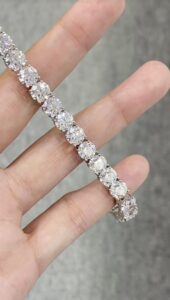
A continuous line of near-equal stones, traditionally in four-prong basket settings.
The name describes construction rather than a specification. What defines the piece practically is that the stones are close in size along the whole run, which is the hardest matching problem in jewellery: any stone visibly different in size or colour breaks the line, and the eye finds it immediately. Total carat weight is the sum across the run, so a bracelet with many small stones can carry a larger total than a shorter one with bigger stones.
Ask for total weight, stone count, the size of each stone and the tolerance within which they are matched. The tolerance is the number that predicts how the line will read.
Stone count, size and weight
Three numbers that describe the piece, in place of one that does not.
| Element | What it controls | Typical range | Why it matters |
|---|---|---|---|
| Stone size | How the line reads from a distance | 1.5–3.5 mm per stone | Small stones read as a ribbon, large ones as individual |
| Stone count | Setting labour and total weight | 40–90 stones on an average wrist | Labour scales with count, not weight |
| Total carat weight | Price signal only | Depends on the two above | Meaningless without size and count |
| Matching tolerance | How even the line looks | Stated numerically | Determines usable yield from a parcel |
Fit and how a tennis bracelet should sit
Loose enough to move, tight enough not to rotate to the clasp.
A tennis bracelet should have a small amount of slack so the line drapes against the wrist rather than pressing into it, but not so much that it rotates and brings the clasp to the top of the wrist where it catches on everything. The usual allowance above the measured wrist circumference is a small one, and the measure should be taken around the wrist bone rather than below it.
Because a tennis bracelet is a fixed line, it cannot be adjusted after production without removing stones. Length has to be right at the order stage. Our notes on measuring a wrist for a bracelet cover the measurement in detail.
Clasps and security
The single component most likely to end the bracelet’s life on a pavement.
A box clasp with a figure-eight safety is the conventional closure for a continuous line, because it carries load across a broad internal tongue and closes inside the line. A lobster clasp is adequate for a light chain bracelet but is a weak point on a heavy continuous line. Regardless of type, a secondary safety should be present and independently operable.
The check takes seconds: close the clasp, apply gentle opposing tension, and confirm the safety engages without force and releases without a tool.
Metals and finishes
Metal choice affects setting security on a piece that is handled repeatedly.
White gold is the standard for high stone counts because it holds settings securely and can be rhodium plated for brightness, though the plating wears at the clasp and along the line. Yellow and rose gold do not tarnish and hide fine scratches better. Platinum holds prongs longest and is the heaviest. Sterling silver is the accessible option and works well for lighter stones and moderate counts, though silver prongs in a continuously worn line need inspection more often.
Match the metal to the rest of a set if the bracelet is worn with other pieces, since different alloys rubbing together wear at different rates.
What to inspect on delivery
Six checks, in the order they matter.
One: clasp and safety operating firmly at every attempt. Two: end links articulated rather than fixed. Three: the line lying flat when laid out and draping in a smooth curve when lifted by one end. Four: every stone seated and immobile under a light touch, with uniform prong tips. Five: length and stone count matching the order and the specification sheet. Six: metal weight and hallmarking consistent with what was ordered.
The documentation should travel with the piece: stone specification, matching tolerance, metal details and length.

Care and storage
Store flat and separately, and clean along the line rather than at a few stones.
A tennis bracelet should be stored flat, in its own compartment, with the clasp closed and the safety open, so the line does not press on itself. Coiling it in a shared box presses prongs against neighbouring settings and is a common cause of bent claws. Cleaning with warm water and mild soap, brushing along the line to lift oils from the settings, keeps the stones returning light.
Avoid chlorinated water, and avoid ultrasonic cleaning unless the maker confirms the settings tolerate it.
What moves the price
Stone count and matching tolerance, more than any single grade.
Across a run of dozens of stones, matching is the constraint that determines how much of a parcel can be used, and a tighter tolerance reduces yield. Setting labour scales with stone count, so a line of many small stones can cost more to make than one with fewer larger stones. The clasp and safety are small line items that decide whether the piece survives.
When comparing quotes, compare stone count, size range, matching tolerance, setting type and clasp class — not total carat weight alone. The same principle applies to tennis necklaces, where the run is longer and the load greater.
FAQ
What is a tennis bracelet?
A bracelet made as a continuous line of near-equal diamonds, traditionally set in four-prong baskets, running the full length of the piece. The defining feature is consistency: every stone should match its neighbours in size and colour so the bracelet reads as one line rather than a series of separate stones.
How much is a lab diamond tennis bracelet?
The price depends on stone size, stone count, matching tolerance, metal and clasp class. Total carat weight alone does not describe the piece, because a bracelet of many small stones can weigh more than one with fewer larger stones while looking quite different. Ask for size range and count alongside the total.
How should a tennis bracelet fit?
It should have a small amount of slack so the line drapes against the wrist rather than pressing into it, but not so much that it rotates and brings the clasp to the top of the wrist. Because it is a fixed line, the length has to be right at the order stage.
Do tennis bracelets fall off easily?
They can, and the cause is almost always the clasp or the end links rather than the line. A box clasp with a figure-eight safety, articulated end links and a clasp that engages firmly at every attempt are the three specifications that prevent it. A lobster clasp on a heavy continuous line is the common weak point.
Sources and further reading
- GIA 4Cs — grading factors for matched stone runs
- GIA Report Check — verifying stone documentation
- International Gemological Institute — diamond grading and reports
- Assay Office — precious metal standards and hallmarking
- The Silver Institute — silver behaviour in bracelet construction
- CIBJO Blue Books — jewellery terminology and disclosure
Next step: Send the wrist measurement, the stone size you are considering and the tolerance you can accept, and we will confirm the stone count, clasp class and setting type, then sample the line before the order runs. Ready-stock bracelets and OEM programmes are both available. Contact vinico@zkzdiamonds.com or WhatsApp +86 135 3037 8229.
{“@context”:”https://schema.org”,”@type”:”FAQPage”,”mainEntity”:[{“@type”:”Question”,”name”:”What is a tennis bracelet?”,”acceptedAnswer”:{“@type”:”Answer”,”text”:”A bracelet made as a continuous line of near-equal diamonds, traditionally set in four-prong baskets, running the full length of the piece. The defining feature is consistency: every stone should match its neighbours in size and colour so the bracelet reads as one line rather than a series of separate stones.”}},{“@type”:”Question”,”name”:”How much is a lab diamond tennis bracelet?”,”acceptedAnswer”:{“@type”:”Answer”,”text”:”The price depends on stone size, stone count, matching tolerance, metal and clasp class. Total carat weight alone does not describe the piece, because a bracelet of many small stones can weigh more than one with fewer larger stones while looking quite different. Ask for size range and count alongside the total.”}},{“@type”:”Question”,”name”:”How should a tennis bracelet fit?”,”acceptedAnswer”:{“@type”:”Answer”,”text”:”It should have a small amount of slack so the line drapes against the wrist rather than pressing into it, but not so much that it rotates and brings the clasp to the top of the wrist. Because it is a fixed line, the length has to be right at the order stage.”}},{“@type”:”Question”,”name”:”Do tennis bracelets fall off easily?”,”acceptedAnswer”:{“@type”:”Answer”,”text”:”They can, and the cause is almost always the clasp or the end links rather than the line. A box clasp with a figure-eight safety, articulated end links and a clasp that engages firmly at every attempt are the three specifications that prevent it. A lobster clasp on a heavy continuous line is the common weak point.”}}]}
Part of our sterling silver bracelets guide.
Recommended
 Does a lab-grown diamond need Kimberley Process paperwork when shipped?Lab Grown Diamond Guide
 Is it better to buy a loose lab-grown diamond and set it, or buy finished jewelry?Lab Grown Diamond Guide
 Is Lab Grown Diamond Jewelry a Good Investment?Buying Guides
 What is a “hearts and arrows” cut, and is it available in lab-grown stones?Lab Grown DiamondsDoes a lab-grown diamond need an appraisal, and what does one include?Lab Grown Diamonds
 Custom Lab Grown Diamond Jewelry: A Step-by-Step GuideCustom Jewelry