What does fluorescence mean on a lab-grown diamond report?
925 sterling silver jewellery, set with lab grown diamonds and made in our own Shenzhen workshop.

Talk · Materials & stone knowledge
A buyer reads a diamond report that lists "Fluorescence: Faint" and wonders whether it is a flaw, whether it affects the look of the stone and whether it matters on a lab-grown diamond used in jewelry.
 ZKZ Editorial TeamMain answer · Product & gemmology desk
Fluorescence is a glow that some diamonds give off under ultraviolet light, usually blue. It is a characteristic of the stone, not a grade and not a flaw. For most people, it has little or no visible effect in normal light, but you should still look at the actual stone in daylight, and check what the report for your stone says.
What fluorescence is
Fact GIA describes fluorescence as the visible light that some diamonds emit when exposed to long-wave ultraviolet light, such as sunlight. The glow is usually blue, and more rarely yellow or green, and it stops when the UV source is removed.
Fact GIA says that fluorescence is not a grading factor like the 4Cs, but is an identifying characteristic, reported by intensity as None, Faint, Medium, Strong or Very Strong on its mined-diamond reports.
Does it change how a diamond looks?
Fact GIA's research found that for the average observer no systematic effect of fluorescence was detected, and that strongly blue fluorescent diamonds were generally perceived as having a slightly better colour appearance when viewed table-up. It also says fluorescence does not itself cause haziness, and that the hazy effect, where it occurs, is linked to rare light-scattering defects.
Fact GIA notes that in the trade, some higher-colour diamonds with strong fluorescence sell for less, even though their colour and transparency are most likely unaffected.
Our advice So a stone with faint or medium fluorescence is not a problem for most buyers, and a bargain price for a strongly fluorescent stone can be good value, provided that you look at it yourself.
On a lab-grown diamond report
Uncertain GIA's description above is based on mined diamonds. We could not confirm from the laboratories' own pages how fluorescence is reported for every kind of laboratory-grown diamond report. GIA's current laboratory-grown service gives a Premium or Standard assessment, not a full grading report, and other laboratories may report fluorescence differently. Read the report you are given.
How to check
- Look at the stone in daylight and indoor light, against white paper.
- Compare it with a stone that has no fluorescence, if you can.
- Check for haziness or a milky look, which is the visual effect people worry about.
- Ask the seller whether the stone has been viewed under UV light and what was seen.
It depends Whether you prefer a fluorescent stone is personal. Some people like the glow under a UV or black light, and others prefer none.
Our advice If you are comparing two stones of the same grade, treat fluorescence as one of many details, and rely on what you see.
Related reading: Lab Grown Diamond Certification: IGI, GIA and What to Check · How to Choose a Lab Diamond: The 4Cs Without the Jargon
Sources
- GIA 4Cs, Diamond fluorescence
- GIA, Updated laboratory-grown diamond services (launched October 1, 2025)
Fact = stated by the cited source. Our advice = editorial recommendation. Uncertain / it depends = limits of what can be said in general.
Other perspectives from the ZKZ team
Report only what the document says. If a report does not mention fluorescence, do not state a level in the listing, and do not describe it as a grade.
Do not pay extra to avoid fluorescence unless the stone looks hazy to you. For most buyers, the look in daylight is a better test than the report line.
Fluorescence does not change how you care for a diamond. Clean it in the same way, with warm water, mild soap and a soft brush.
Have a different question? Ask our team, or browse more answers in Talk.
Related products
Related articles & topics
- What does "cultured diamond" mean, and is it the same as lab-grown?Talk
- Can a seller call a lab-grown diamond "real" or "conflict-free"?Talk
- Can a Lab-Grown Diamond Pass a Diamond Tester?Talk
- Will a Lab-Grown Diamond Hold Its Resale Value?Talk
- Is a Lab-Grown Diamond on Sterling Silver a Good Engagement Ring for Daily Wear?Talk
- What Are Lab Grown Diamonds? A Plain-English ExplanationGuide
- Lab Diamond Necklace Lengths and LayeringGuide
- Lab Diamond vs Moissanite: Differences and Which to BuyGuide
- Lab Diamond Hoops and Drop Earrings: Styles and WeightGuide
- Lab Diamond Bracelets for Everyday Wear: Styles and DurabilityGuide
Recommended
 What is the difference between GIA, IGI and in-house reports for lab-grown diamonds?Talk
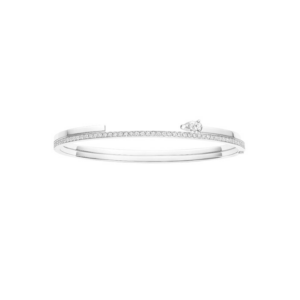 What bracelet size should I order if I have a small, medium or large wrist?Talk
 What are flat-back studs, and who needs them for cartilage or sleeping?TalkWhat jewelry suits an engagement-party or bridal-shower gift?Talk
 Can nickel-free silver jewelry still cause a reaction?Talk
 What are the black spots on my silver jewelry, and are they damage or tarnish?Talk