Lab Grown Diamond Necklaces: Styles, Sizes and How to Choose
925 sterling silver jewellery, set with lab grown diamonds and made in our own Shenzhen workshop.
A lab grown diamond necklace is usually bought against a much simpler brief than a ring. There is no sizing problem, no stone choice made under pressure in a shop, and no need to balance four grades against one another. What the purchase actually turns on is how the line behaves on the neck: where it sits, whether it turns, how secure the clasp is, and whether the total carat weight lands where the eye expects it. Buyers who decide those three things first find the rest of the specification follows.
Last updated:
Which necklace style fits which use case?
Match the style to how often the piece will be worn, not to how it photographs.
A continuous line of stones is the most formal and the most demanding to make well, because a single mismatched stone is visible across the run. A single-stone pendant is the most wearable and the easiest to build consistently. Station and spaced settings sit between the two: they carry sparkle along the neckline without requiring a perfectly matched continuous line.
For a first lab grown diamond necklace, a pendant or a spaced design is more forgiving. For a signature piece or a collection centrepiece, the continuous line justifies its higher matching cost.
Rivière, tennis, station and solitaire: how they differ
The names describe construction, not stone quality.
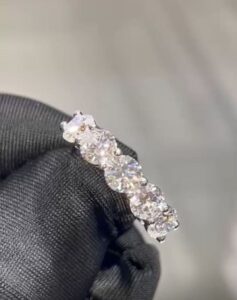
A rivière is a continuous graduated line, usually with the largest stone at the centre. A tennis necklace is a continuous line of near-equal stones, historically in a four-prong basket setting. A station necklace spaces a small number of stones along a chain, and a solitaire pendant carries one stone on a bail. Each construction places different demands on matching, setting labour and clasp choice.
| Style | Construction | Matching demand | Best use |
|---|---|---|---|
| Riviere | Continuous, graduated | High — graduation must read evenly | Formal, centrepiece |
| Tennis | Continuous, uniform stones | Highest — every stone visible against its neighbour | Signature daily-wear piece |
| Station | Spaced stones on a chain | Moderate | Everyday, layering |
| Solitaire pendant | Single stone on a bail | Low | First purchase, gifts |
Stone size: total carat versus centre carat
The two numbers describe different things, and quotes often use whichever sounds larger.
Total carat weight is the sum of every stone in the piece. Centre carat is the weight of the principal stone. A graduated rivière with a 1.00 ct centre may carry a much larger total weight across the line, while a pendant with the same total weight might be a single 1.00 ct stone plus a small accent. Comparing a total figure with a centre figure is one of the most common errors in necklace shopping.
Ask for both, plus the count and the individual size range, and the quote becomes comparable.
Length and drop
The right length depends on the neckline and on where the heaviest part of the piece sits.
A choker-length line sits at the base of the neck and reads as a band; a collarbone-length piece sits just below the clavicle and is the most versatile position; a longer chain drops the pendant or the lowest point of the line into the chest, which changes both the visual effect and how much the piece swings. Graduated rivières are especially sensitive to length, because the graduation is designed to be seen at a particular position.
For layering, keep the lengths visibly different rather than close together, and keep the heavier line underneath.
Clasp and security by style
On a continuous line, the clasp is the single point of failure.
A box clasp with a figure-eight safety catch is the conventional closure for a tennis or rivière necklace because it distributes load and hides inside the line. A lobster clasp is adequate for a pendant on a chain but is a weak point on a heavy continuous line. Whichever closure is used, the piece should have a secondary safety: a figure-eight, a hook, or a short chain with a catch.
Ask how the clasp is rated against the weight of the piece, and ask whether it can be replaced independently if it wears. Cleaning and storage follow the same principles as any fine chain, set out in our necklace care guide.
Metal choice: silver, gold and platinum
Metal affects setting security, colour of the piece and the price more than the stone grade does.
Sterling silver is the accessible option and works well for pendants and station designs, though it is softer and its settings tolerate less daily strain in a heavy continuous line. White gold is the standard for high-stone-count pieces because it holds settings securely and can be rhodium plated for brightness. Yellow and rose gold change the perceived colour of the stones and hide wear differently. Platinum is the most durable and the most expensive.
For a first fine necklace in this category, silver or 14K gold covers most use cases; for a continuous line above a modest stone count, white gold is the practical default.
Budget allocation
Spend on the stones that are seen most and on the setting that will be handled most.
On a pendant, the centre stone is the whole visual, so it is worth the larger share of the budget. On a continuous line, the eye reads the run rather than any single stone, so money is better spent on matching and on graduation than on upgrading one or two stones in the line. On every style, the clasp and the jump ring are the cheapest components and the most common reason a piece comes back.
Where cut quality is available without a rarity premium, it belongs higher in the priority list than a colour step.
Lead time and ready stock
Stock styles ship quickly; matched continuous lines take longer because of selection.
A pendant built from a stock stone and a stock chain is a short job. A rivière or tennis line requires assembling a matched run, which means selection time on top of production, and a tight matching tolerance lengthens it further. Where the design allows, building around sizes already held in stock removes most of the delay.
Ask for the sequence rather than one number: stone selection, setting, finishing and inspection each have their own timeline.
Quality checks before dispatch
Five checks that catch most necklace defects.
One: every stone seated, with no movement under a light touch. Two: prongs uniform in size and finish, with no sharp edges at the neckline. Three: the line lies flat when laid out and does not twist when lifted. Four: the clasp engages fully and the safety catch closes without force. Five: measurements match the order — total length, drop at the centre, and stone count.
At our end, pieces are inspected against the approved sample and the specification sheet before packing, and the documentation that travels with the piece is checked against the purchase order.
FAQ
How do I choose a lab grown diamond necklace?
Decide the three things that affect wear first: the style, which sets how much matching the piece needs; the length, which decides where the line sits on the neck; and the clasp, which decides how secure a heavy piece is. Stone grades come after those, because they change appearance less than construction does.
What is the difference between total carat and centre carat?
Total carat weight is the sum of all stones in the piece; centre carat is the weight of the main stone only. A graduated riviere can carry a large total weight while its centre stone is a fraction of that, so quotes should state both, along with the number of stones and their size range.
Is a lab grown diamond necklace worth buying?
It offers the same material and appearance as a mined diamond necklace at a lower price, which makes larger stone counts and larger centre stones accessible. Treat it as a purchase rather than an investment, and put the budget where it shows: matching on a continuous line, and the centre stone on a pendant.
Can a diamond necklace be shortened or lengthened later?
A pendant on a chain usually can, because the chain can be re-clasped or replaced. A continuous riviere or tennis line cannot be shortened without removing stones and rebuilding the clasp, and lengthening it requires matching stones that may no longer be available. Specify length carefully at the order stage.
Sources and further reading
- GIA 4Cs — how cut, colour, clarity and carat weight are defined
- GIA — diamond grading overview
- International Gemological Institute — diamond and jewellery grading
- Assay Office — precious metal standards for gold, silver and platinum
- CIBJO Blue Books — diamond and precious metal terminology
- International Gem Society — jewellery construction and setting reference
Next step: Tell us the style, the length and the stone sizes you have in mind, and we will confirm what can be built from stock, what requires matching, and the documentation each piece will carry. Ready-stock necklaces dispatch in days, and OEM/ODM necklace programmes are quoted per parcel. Contact vinico@zkzdiamonds.com or WhatsApp +86 135 3037 8229.
Part of our sterling silver necklaces and pendants guide.
Recommended
 Does a lab-grown diamond need Kimberley Process paperwork when shipped?Lab Grown Diamond Guide
 Is it better to buy a loose lab-grown diamond and set it, or buy finished jewelry?Lab Grown Diamond Guide
 Is Lab Grown Diamond Jewelry a Good Investment?Buying Guides
 What is a “hearts and arrows” cut, and is it available in lab-grown stones?Lab Grown DiamondsDoes a lab-grown diamond need an appraisal, and what does one include?Lab Grown Diamonds
 Custom Lab Grown Diamond Jewelry: A Step-by-Step GuideCustom Jewelry