Lab Grown Diamond Engagement Rings: A Buyer’s Guide
925 sterling silver jewellery, set with lab grown diamonds and made in our own Shenzhen workshop.
Two engagement rings can hold the same centre stone and still differ by more than a millimetre in band width, more than a gram in weight, and several hundred dollars in price. Buyers spend their research on the stone and their money on the setting without noticing that the second decision is the one they will feel every day. A ring is worn continuously, which makes band width, setting height, metal hardness and fit into practical questions rather than aesthetic ones. This guide works through them in the order a buyer actually decides.
What actually decides whether an engagement ring works?
Fit and setting height, before stone quality.
A ring that spins, digs into the neighbouring fingers or catches on clothing gets taken off, and a ring that is taken off eventually gets lost or damaged. Those problems come from the band and the setting, not from the diamond. Width, profile, metal hardness and setting height together decide whether the ring stays comfortable through a working day.
Stone quality then decides how the piece looks, and documentation decides what happens if it is ever insured, appraised or resold. Those are three separate decisions, and treating them separately is what keeps a purchase from going wrong.
Starting from the stone or from the setting
Start from the setting if the ring will be worn daily; start from the stone if the piece is primarily a statement.
The centre stone can be chosen within a range and still look excellent once set, because a well-cut stone of modest grades in a good setting outperforms a poorly proportioned one in a thin mounting. The reverse is not true: a fine stone in a setting that twists, sits too high or has prongs that catch will still be uncomfortable and still need repair.
In practice, buyers set a stone budget range, then settle the setting, then choose the stone inside the range against the setting’s constraints — particularly the height and the number of prongs, both of which limit what size can be held safely.
Settings and styles compared
Each style trades protection, apparent size and snag risk against the others.
| Setting | Look | Snag risk | Apparent size | Best for |
|---|---|---|---|---|
| Solitaire four-prong | Stone forward, minimal metal | Moderate | True to size | Classic daily wear |
| Six-prong | Slightly wider coverage | Moderate | True to size | Larger stones, more grip |
| Halo | Ring of small stones around the centre | High | Noticeably larger | Maximum presence per carat |
| Pave band | Stones along the shoulders | High | Adds sparkle, not size | Design-led pieces |
| Bezel | Continuous rim of metal | Lowest | Slightly larger | Active hands, daily wear |
| Three-stone | Centre plus two sides | Moderate | Wider on the hand | Traditional profile |
The 4Cs and how to prioritise them
Cut first, then carat, then colour, then clarity.
Cut determines how much light returns to the eye, and in lab grown supply a well-proportioned stone is broadly available rather than a rarity, so it costs little to insist on. Carat determines size and price, which makes it the main budgeting lever. Colour steps near the top of the scale are expensive and barely visible once the stone is set. Clarity steps above a modest grade are the least visible of all, because inclusions below the table are hidden by the setting and the ring’s own shadow.
Buyers who understand this spend on cut and size, accept near-colourless colour, and take a clarity grade that is clean to the eye — which frees budget for the setting that will actually be worn.
Metal choices and durability
The metal decides how often the ring is re-polished or re-plated.
White gold is the conventional choice and is normally rhodium plated, so it needs re-plating periodically at the contact points. Yellow and rose gold do not tarnish and hide fine scratches better, but the colour can compete with a very white stone. Platinum is the most durable and the heaviest, and holds prongs longest, which matters on a ring worn daily. Sterling silver is the accessible option and works for lighter stones; on a heavy centre stone in a thin band, silver prongs wear faster and need inspection more often.
Between karats, 14K is the usual working compromise for hardness, while 18K takes a higher polish and is the traditional choice for more valuable stones.
Sizing and fit for a ring worn daily
Comfort, not the measurement on a chart, decides the size.
Finger size changes with temperature, time of day and season, and a ring that fits perfectly in a warm afternoon can be loose in the morning. The usual rule is to size for the larger of the two, because a slightly loose ring can be worn and a tight one cannot. Band width affects fit as well: a wide band feels tighter than a narrow one at the same internal diameter, and a knife-edge profile feels tighter than a comfort-fit interior.
For a ring that will be worn continuously, comfort-fit inside profiles and a moderate width are the practical specification.
Wedding band pairing
Decide the pairing before the engagement ring is made, not after.
A ring with a low setting can usually sit flush against a plain band, while a ring with a high setting or a halo leaves a gap that a curved or shaped band has to fill. If the pairing is not planned, the wedding band either does not sit flush or has to be custom-shaped later, which is slower and more expensive. The simplest solution is to specify a band that matches the engagement ring’s profile at the same time.
Metal should also match, because two different alloys against each other wear at different rates and can show it at the contact point.
Certification and documentation
A report for the centre stone, and a written specification for the rest.
For a stone sold individually, a grading report from a recognised laboratory is the practical minimum, with a number that can be verified online. For the piece, the documentation should state the metal and its hallmark, the setting type, the stone count and size range for accent stones, and the total carat weight of the finished ring.
Our own parcels are selected and matched against the agreed specification and the documentation that travels with each shipment is confirmed against the purchase order before dispatch.
Budget and value
Split the budget explicitly between stone, setting and metal.
Buyers who allocate a single number and then shop tend to overspend on the stone and under-specify the band. A more reliable approach is to fix a range for the stone, a separate allowance for the setting and metal, and a small reserve for sizing and any later adjustment. Lab grown stones make larger centre stones accessible, which is exactly why the setting deserves its own line rather than being treated as a leftover.
The practical test is whether the ring still looks considered if the centre stone were one grade lower and the band one specification better. The breakdown of what drives lab grown diamond prices explains which line items move the total most.
What to check before you commit
Six points that prevent most engagement ring problems.
Confirm the ring size against a fitting in the conditions the ring will be worn, not a measurement taken cold. Confirm the setting height and check that it does not catch when a hand brushes fabric. Confirm the band width and profile. Confirm the metal and whether it is plated, and how that plating will be maintained. Confirm the report and its verifiable number for the centre stone. And confirm how the pairing wedding band will sit, ideally with a sample.
Where the ring is being made rather than bought from stock, approve a sample or a rendering against those six points before production begins.
FAQ
Are lab grown diamond engagement rings worth it?
For buyers choosing on appearance and budget rather than resale, yes: the material is identical to a mined diamond and the price is lower, which makes a larger or better-cut centre stone reachable. Treat the purchase as a cost rather than an investment and allocate part of the saving to the setting and band, which are worn every day.
How do I choose a lab diamond ring?
Start from the setting and fit, because those decide comfort and durability, then choose the stone inside the range the setting can hold safely. Prioritise cut, then size, then colour, then clarity. Confirm the metal and its plating, the report for the centre stone, and how a matching wedding band will sit.
Is a half eternity or full eternity band better for a wedding ring?
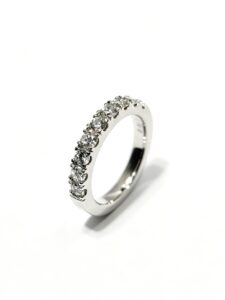
A half eternity covers the visible part of the band and can be resized, because the plain section at the bottom is where a jeweller works. A full eternity looks consistent all the way round but cannot be resized without rebuilding the ring, so it has to be correct at the start.
Can a lab grown diamond ring be resized later?
Usually yes, with limits. A plain or half-eternity band can generally be adjusted by one or two sizes. A full eternity band, a pave shoulder or a channel-set band can be difficult or impossible to resize without rebuilding, because the stones run through the section that would have to be cut.
Sources and further reading
- GIA 4Cs — how cut, colour, clarity and carat are assessed
- GIA Report Check — verify a grading report number
- International Gemological Institute — diamond grading and reports
- Assay Office — precious metal standards for gold, silver and platinum
- CIBJO Blue Books — diamond and precious metal nomenclature
- International Gem Society — setting and ring construction reference
Next step: Tell us the centre stone size you have in mind, how the ring will be worn and whether a wedding band will sit against it, and we will specify the setting, band width, profile and metal, then quote the stone against that specification. Ready-stock rings and OEM programmes are both available. Contact vinico@zkzdiamonds.com or WhatsApp +86 135 3037 8229.
{“@context”:”https://schema.org”,”@type”:”FAQPage”,”mainEntity”:[{“@type”:”Question”,”name”:”Are lab grown diamond engagement rings worth it?”,”acceptedAnswer”:{“@type”:”Answer”,”text”:”For buyers choosing on appearance and budget rather than resale, yes: the material is identical to a mined diamond and the price is lower, which makes a larger or better-cut centre stone reachable. Treat the purchase as a cost rather than an investment and allocate part of the saving to the setting and band, which are worn every day.”}},{“@type”:”Question”,”name”:”How do I choose a lab diamond ring?”,”acceptedAnswer”:{“@type”:”Answer”,”text”:”Start from the setting and fit, because those decide comfort and durability, then choose the stone inside the range the setting can hold safely. Prioritise cut, then size, then colour, then clarity. Confirm the metal and its plating, the report for the centre stone, and how a matching wedding band will sit.”}},{“@type”:”Question”,”name”:”Is a half eternity or full eternity band better for a wedding ring?”,”acceptedAnswer”:{“@type”:”Answer”,”text”:”A half eternity covers the visible part of the band and can be resized, because the plain section at the bottom is where a jeweller works. A full eternity looks consistent all the way round but cannot be resized without rebuilding the ring, so it has to be correct at the start.”}},{“@type”:”Question”,”name”:”Can a lab grown diamond ring be resized later?”,”acceptedAnswer”:{“@type”:”Answer”,”text”:”Usually yes, with limits. A plain or half-eternity band can generally be adjusted by one or two sizes. A full eternity band, a pave shoulder or a channel-set band can be difficult or impossible to resize without rebuilding, because the stones run through the section that would have to be cut.”}}]}
Part of our sterling silver rings guide.
Recommended
 Does a lab-grown diamond need Kimberley Process paperwork when shipped?Lab Grown Diamond Guide
 Is it better to buy a loose lab-grown diamond and set it, or buy finished jewelry?Lab Grown Diamond GuideHow do I choose a bypass or open ring that stays comfortable?Lab Grown Diamond Rings
 How do I choose between a solitaire, halo and three-stone ring?Lab Grown Diamond Rings
 Is Lab Grown Diamond Jewelry a Good Investment?Buying Guides
 What is a “hearts and arrows” cut, and is it available in lab-grown stones?Lab Grown Diamonds