How does cubic zirconia differ from a lab-grown diamond in silver?
925 sterling silver jewellery, set with lab grown diamonds and made in our own Shenzhen workshop.
Talk · Lab-Grown Diamond Knowledge
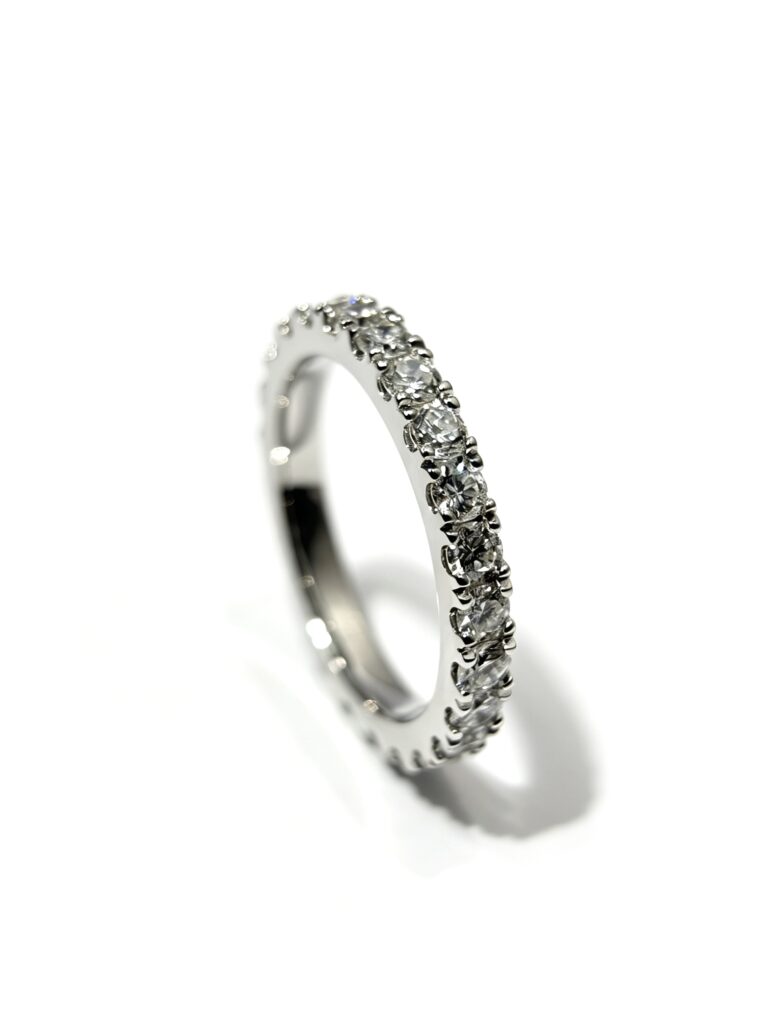
A buyer sees two silver rings that look alike, one set with cubic zirconia and one with a lab-grown diamond, at very different prices. They ask what actually separates the stones and which suits daily wear.
 ZKZ Editorial TeamMain answer · Product & gemmology desk
Cubic zirconia (CZ) is a different material from a diamond. A lab-grown diamond is a diamond that was made in a lab, with the same basic composition and structure as a mined one. CZ is a simulant that only resembles it.
The materials
Fact The FTC Jewelry Guides define a diamond as a mineral of essentially pure carbon crystallised in the isometric system, with a hardness of 10, a specific gravity of about 3.52 and a refractive index of 2.42 (16 CFR 23.12).
Fact The Guides also say a laboratory-grown stone may be called by the gem name only with a clear qualifier such as "laboratory-grown", and that an imitation should be identified as imitation or simulated (16 CFR 23.25).
Our advice In plain terms, a lab-grown diamond is a diamond. CZ is zirconium oxide, so it should never be sold as "diamond" without clear labelling as an imitation.
What this means for you
- Look: a lab-grown diamond and CZ can look alike at a glance. Trained eyes and simple tools can tell them apart.
- Durability: the Guides give diamond a hardness of 10. We generally find CZ scratches and dulls sooner, though we do not cite a figure here.
- Care: both can be cleaned with warm soapy water and a soft brush. Keep both out of harsh chemicals.
- Price: the difference reflects the material, and often the grading documents that come with a lab-grown stone.
How to tell what you are buying
- Read the listing for the words "laboratory-grown diamond" or "cubic zirconia".
- Look for a report number from an independent laboratory for the diamond.
- Ask what the stone is if the listing only says "stone" or "gem".
Which suits daily wear
It depends If you wear the ring every day and want a diamond, choose the lab-grown diamond. If you want a lower-cost fashion piece and are happy to replace it, CZ can be reasonable. It depends on budget and how long you expect to keep it.
Uncertain We cannot compare exact scratch resistance here with a cited number, so treat our durability remark as experience, not a test result.
Related reading: Can a Lab-Grown Diamond Pass a Diamond Tester? · Lab Grown Diamond Earrings in Silver: Buying Checklist
Sources
- 16 CFR 23.12, FTC Jewelry Guides: definition and misuse of the word "diamond"
- 16 CFR 23.25, FTC Jewelry Guides: misuse of "ruby", "sapphire", "emerald", "birthstone", "gem" and similar words
- GIA, Diamond care and cleaning
Fact = stated by the cited source. Our advice = editorial recommendation. Uncertain / it depends = limits of what can be said in general.
Other perspectives from the ZKZ team
Decide first whether you want a diamond or a look-alike. If you want a diamond, ask for the report number and check it with the laboratory.
Words such as "diamond-like", "faux diamond" or "simulated diamond" need care. The FTC Guides say "faux" is not an adequate disclosure on its own, so the listing should state plainly what the stone is.
Both stones can clog with oils and soap, which dulls the sparkle. A gentle clean every few weeks restores more shine than most buyers expect.
Have a different question? Ask our team, or browse more answers in Talk.
Related products
Related articles & topics
- How do I choose jewelry for a bride in silver and lab-grown diamond?Talk
- What is lab-grown white sapphire, and how does it compare with a lab diamond in silver?Talk
- Is a Lab-Grown Diamond on Sterling Silver a Good Engagement Ring for Daily Wear?Talk
- What should a lab-grown diamond disclosure look like on a product page?Talk
- Can a Lab-Grown Diamond Pass a Diamond Tester?Talk
- Lab Grown Diamond Engagement Rings: A Buyer’s GuideGuide
- Wholesale Lab Diamond Jewelry: What Buyers Should VerifyGuide
- Silver Engagement Rings With Lab Diamonds: Pros and ConsGuide
- Lab Diamond vs Moissanite: Differences and Which to BuyGuide
- Caring for a Lab Diamond Necklace: Cleaning and StorageGuide
Recommended
 What is the difference between GIA, IGI and in-house reports for lab-grown diamonds?Talk
 What bracelet size should I order if I have a small, medium or large wrist?Talk
 What are flat-back studs, and who needs them for cartilage or sleeping?TalkWhat jewelry suits an engagement-party or bridal-shower gift?Talk
 Can nickel-free silver jewelry still cause a reaction?Talk
 What are the black spots on my silver jewelry, and are they damage or tarnish?Talk