Why does my diamond look a different colour in different lighting?
925 sterling silver jewellery, set with lab grown diamonds and made in our own Shenzhen workshop.

Talk · Troubleshooting
A buyer sees their lab-grown diamond look icy white in the shop, a little warmer at home and bluish outdoors. They wonder whether the stone is changing or the report was wrong.
 ZKZ Editorial TeamMain answer · Product & gemmology desk
The stone is not changing. Diamonds reflect and pass on the light around them, so the colour you see depends on the light source, the background, the metal and your clothes. Grading laboratories use a standard viewing environment so that colour is judged under fixed conditions. To judge a stone for yourself, compare it with other stones under the same lights.
Why lighting matters
Fact GIA says that because light source and background can have a significant impact on the appearance of colour, a diamond's colour is graded in a standardized viewing environment.
Our advice Warm, yellowish bulbs make stones look warmer, and cool or daylight-type light makes them look whiter. Bright spotlights in shops can bring out sparkle that a dim room does not.
Fluorescence
Fact GIA says that some diamonds fluoresce, giving off a bluish or, rarely, another colour of light, when exposed to long-wave ultraviolet light from sources such as the sun, and that the glow stops when the light source is removed.
Our advice If your stone fluoresces, outdoor light may give it a slightly different look than indoor light. Many people never notice it.
Other things that change what you see
- The metal. A white metal such as rhodium plating makes a stone look whiter than yellow metal.
- Surroundings. Bright clothes and skin tone reflect into the stone.
- Dirt. A film of oil or soap dulls the stone and can make it look greyer.
- Angle. A change in viewing angle can change the flash of colour.
- Cut. A well-cut stone returns more light and can look brighter.
How to judge a stone fairly
- Look at it in daylight near a window, and under indoor light.
- Place it on a white card, face down and then face up, and compare with another stone.
- Clean it first.
- Check the report's colour grade, not your impression in one light.
- Ask for a video, and look at it in several lights.
When to ask the seller
Our advice If the colour looks different from the description in all lights, compare it with the report and ask the seller. If the colour looks much more yellow or grey than the grade, ask for a check.
It depends Small differences between lights are normal, and many people like the variety. A clear difference in all light is a reason to ask.
Uncertain We cannot tell from a description whether a stone matches its grade, since only a comparison with the report can show it.
Related reading: How to Choose a Lab Diamond: The 4Cs Without the Jargon · Coloured Lab Grown Diamonds: Pink, Blue, Yellow and Beyond
Sources
Fact = stated by the cited source. Our advice = editorial recommendation. Uncertain / it depends = limits of what can be said in general.
Other perspectives from the ZKZ team
Choose a stone in the light you will see it in most. If you wear it mainly indoors, look at it indoors, and do not choose only from a shop spotlight.
A seller should describe colour by the report grade, and not by words such as "icy white", which depend on lighting and are not a grade.
Clean the stone before you judge it. A film of lotion and soap can change the look more than the light does.
Have a different question? Ask our team, or browse more answers in Talk.
Related products
Related articles & topics
- Why do two similar lab diamond rings have very different prices?Talk
- What colour grade is enough for a lab diamond set in white-plated silver?Talk
- What should a lab-grown diamond disclosure look like on a product page?Talk
- What does "cultured diamond" mean, and is it the same as lab-grown?Talk
- Can I wear a diamond ring for manual work?Talk
- Solitaire Pendant vs Diamond Necklace: Which Suits You?Guide
- Diamond Stud Size Guide: 0.5 ct to 3 ct on the EarGuide
- Lab Grown Diamond Necklaces: Styles, Sizes and How to ChooseGuide
- Lab Grown Diamond Pendants: Solitaire, Halo and Bezel StylesGuide
- Prong vs Bezel vs Halo Settings for Diamond EarringsGuide
Recommended
 What is the difference between GIA, IGI and in-house reports for lab-grown diamonds?Talk
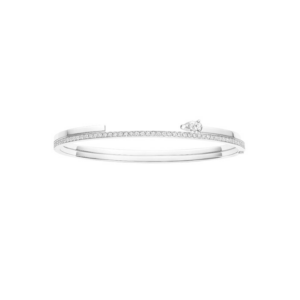 What bracelet size should I order if I have a small, medium or large wrist?Talk
 What are flat-back studs, and who needs them for cartilage or sleeping?TalkWhat jewelry suits an engagement-party or bridal-shower gift?Talk
 Can nickel-free silver jewelry still cause a reaction?Talk
 What are the black spots on my silver jewelry, and are they damage or tarnish?Talk