How thick should a silver ring band be for daily wear?
925 sterling silver jewellery, set with lab grown diamonds and made in our own Shenzhen workshop.
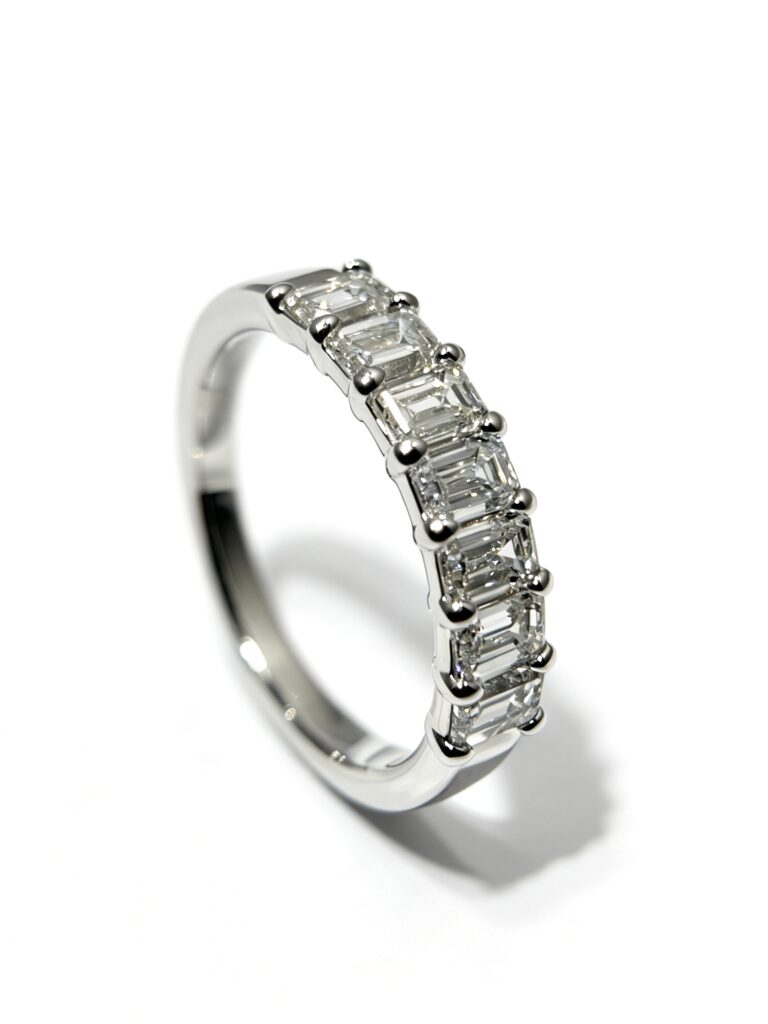
Talk · Selection & sizing
A customer wants a plain sterling silver ring to wear every day and keeps seeing very thin bands. They worry about bending, and ask how thick a band should be, and how to judge it from a listing.
 ZKZ Editorial TeamMain answer · Product & gemmology desk
For daily wear, the band should be thick enough that you cannot bend it with your fingers, and it should have no thin spot, especially at the bottom of the shank. There is no single correct measurement, because silver is soft and the right thickness depends on the width, the profile and any stones. Ask for the thickness at the thinnest point, not only the width.
Width and thickness are different things
- Width is how far the band runs across your finger, from edge to edge.
- Thickness is how deep the metal is from the outside to the inside, at the thinnest point.
A wide, thin band can still flex, while a narrow, thicker band can be much stronger.
Why thickness matters for silver
Fact Sterling silver is at least 925/1,000 pure silver, with the remainder usually other metals, and is softer than gold alloys and much softer than diamond (hardness 10 in the FTC definition).
Our advice Because silver is soft, a thin band can bend under pressure from gripping, from a bag strap or from a door handle, and it can crack at the bottom where it is thinnest. Rings with stones set along the band lose strength at each stone seat, so they need extra thickness.
How to judge a band
- Ask for the thickness at the thinnest point, in millimetres, and the width. If the seller will not give it, ask for a photograph of the ring on a ruler or a calliper.
- Compare it with a ring you already wear. Measure your current ring and use it as a baseline.
- Look at the profile. A comfort-fit, rounded inside is thicker in the middle and more comfortable. A flat inside with sharp edges is less so.
- Consider the weight. A heavier ring in the same design usually has more metal, although not always.
- Check for stone seats and cutouts. The thinnest point is often under a stone or at a hinge.
- Think about your hands. If you work with your hands, choose a thicker band.
What is a sensible compromise?
It depends A slim band can be elegant, and many people wear them without problems, especially if they take them off for heavy tasks. If you like a delicate look, pick a slightly thicker version than you think you need.
Uncertain We do not give a minimum number, because there is no standard for it and the figure depends on the design. If a seller quotes one, ask how it was chosen and whether the ring has been tested.
Care for thin bands
Our advice Do not try to straighten a bent band on your own. Bending metal back and forth work-hardens it and can crack it. Take it to a jeweller.
Related reading: Sterling Silver Rings: How to Choose a Ring That Lasts · Silver Wedding Bands: Durability, Plating and Long-Term Wear
Sources
- 16 CFR 23.12, FTC Jewelry Guides: definition and misuse of the word "diamond"
- 16 CFR 23.5, FTC Jewelry Guides: misrepresentation as to silver content
Fact = stated by the cited source. Our advice = editorial recommendation. Uncertain / it depends = limits of what can be said in general.
Other perspectives from the ZKZ team
If the ring is the one you will wear every day, choose the thicker option, even if it looks a little less delicate in the photos. You will notice the strength more than the extra millimetre.
The weak point is usually at the bottom of the shank, where it is thinnest and where it is cut for sizing. Ask whether that part is reinforced.
Take slim silver rings off for lifting, gardening and carrying bags. Most bent bands are caused by pressure, not by normal wear.
Have a different question? Ask our team, or browse more answers in Talk.
Related products


Related articles & topics
- Is a Lab-Grown Diamond on Sterling Silver a Good Engagement Ring for Daily Wear?Talk
- Does Rhodium Plating Wear Off a Silver Diamond Ring, and Can It Be Redone?Talk
- How do I clean the inside of a ring band where residue builds up?Talk
- Should I insure a sterling silver lab-diamond ring, and what value should I declare?Talk
- Can I wear silver diamond jewelry through airport security and on a flight?Talk
- Silver Earring Backs: Butterfly, Screw, Push and LockingGuide
- Silver Necklace Chains Compared: Box, Cable, Rolo, Snake and FigaroGuide
- Caring for 925 Sterling Silver Jewelry with Lab Grown Diamond SettingsGuide
- Silver vs Gold Settings for Lab Diamond NecklacesGuide
- Resizing and Maintaining a Lab Diamond RingGuide
Recommended
 What is the difference between GIA, IGI and in-house reports for lab-grown diamonds?Talk
 What bracelet size should I order if I have a small, medium or large wrist?Talk
 What are flat-back studs, and who needs them for cartilage or sleeping?TalkWhat jewelry suits an engagement-party or bridal-shower gift?Talk
 Can nickel-free silver jewelry still cause a reaction?Talk
 What are the black spots on my silver jewelry, and are they damage or tarnish?Talk