Why do fancy-shape lab diamonds not get a cut grade?
925 sterling silver jewellery, set with lab grown diamonds and made in our own Shenzhen workshop.

Talk · Materials & stone knowledge
A buyer comparing an oval and a round lab-grown diamond sees "Excellent cut" on the round and no cut grade on the oval. They want to know why, and how to judge the oval.
 ZKZ Editorial TeamMain answer · Product & gemmology desk
Cut grades are only well established for round brilliants. GIA says that an internationally accepted system for visually evaluating the appearance of fancy-cut diamonds does not exist at this time, and it provides a cut grade only for standard round brilliants. For an oval, pear or emerald cut, you judge the cut by looking, by measurements and by a seller's description. Other laboratories may report differently, so read the report.
What GIA says
Fact GIA says that it provides a cut quality grade only for standard round brilliant diamonds in the D-to-Z colour range, based on the stone's proportions, polish and symmetry, and that it considers brightness, fire, scintillation, weight ratio and durability in that assessment.
Fact In an FAQ, GIA also says that an internationally accepted system for visually evaluating the appearance of fancy-cut diamonds does not exist, and that research is underway to develop one. The page may predate recent work, so check GIA's current information.
Fact For laboratory-grown diamonds, GIA's updated services launched on October 1, 2025, classify each stone as Premium or Standard, and Premium requires an Excellent cut for rounds, along with other criteria. There is no equivalent cut requirement stated for fancy shapes.
Uncertain We have not verified how other laboratories report the cut of fancy shapes, and some may give grades or comments. Read each report and ask the seller what it covers.
Why fancy shapes are harder
Our advice Rounds have a standard design that has been studied for a long time. Fancy shapes such as ovals, pears and marquises vary in length-to-width ratio, outline and facet pattern, so there is no single ideal that applies to all.
How to judge a fancy-shape cut
- See it in person. Look at the stone in daylight and indoor light. Check for dark or washed-out areas.
- Look at the "bow-tie". Some elongated shapes show a darker band across the middle. Some bow-tie is normal, and a strong one can look dull.
- Check the outline. Is it symmetrical and pleasing, with even curves and points?
- Check the ratio. Length to width ratio is a matter of taste. Ask for the measurements.
- Check polish and symmetry, if the report gives them.
- Compare stones. Look at several stones of the same shape side by side, or ask for a video.
For the listing
Our advice Describe a fancy shape with its measurements, ratio, polish and symmetry if known, and avoid claiming a cut grade that the report does not give.
It depends Many people choose a fancy shape for its look and size, and not for a cut grade. A stone that you love in daylight is a good sign.
Related reading: Fancy Shape Lab Diamonds: Value and Design Options · Lab Grown Diamond Certification: IGI, GIA and What to Check
Sources
- GIA, How GIA grades a diamond
- GIA, Fancy-shape diamond grading FAQ
- GIA, Updated laboratory-grown diamond services (launched October 1, 2025)
Fact = stated by the cited source. Our advice = editorial recommendation. Uncertain / it depends = limits of what can be said in general.
Other perspectives from the ZKZ team
Do not apply "Excellent cut" to a fancy shape unless the report says so. State the shape, the measurements and what the report covers, and no more.
Ask for a video in daylight and compare two or three stones. With fancy shapes, your eye is a better guide than a number.
A fancy shape with points, such as a pear or marquise, needs protective prongs at the tips. Check them when you have the piece inspected.
Have a different question? Ask our team, or browse more answers in Talk.
Related products
Related articles & topics
- Do Lab-Grown Diamonds Get Cloudy or Lose Their Sparkle Over Time?Talk
- Is a piece with many small diamonds better value than one larger stone?Talk
- Are lab-grown diamonds ever treated, and must treatment be disclosed?Talk
- What colour grade is enough for a lab diamond set in white-plated silver?Talk
- Are Lab-Grown Diamonds Really More Ethical? What to Ask the SellerTalk
- Caring for 925 Sterling Silver Jewelry with Lab Grown Diamond SettingsGuide
- Lab Grown Diamond Pendants: Solitaire, Halo and Bezel StylesGuide
- Lab Grown Diamond Certification: IGI, GIA and What to CheckGuide
- How to Choose a Lab Diamond: The 4Cs Without the JargonGuide
- Lab Grown Diamond Earrings in Silver: Buying ChecklistGuide
Recommended
 What is the difference between GIA, IGI and in-house reports for lab-grown diamonds?Talk
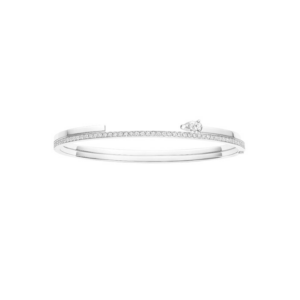 What bracelet size should I order if I have a small, medium or large wrist?Talk
 What are flat-back studs, and who needs them for cartilage or sleeping?TalkWhat jewelry suits an engagement-party or bridal-shower gift?Talk
 Can nickel-free silver jewelry still cause a reaction?Talk
 What are the black spots on my silver jewelry, and are they damage or tarnish?Talk