What does “type IIa” mean for a diamond?
925 sterling silver jewellery, set with lab grown diamonds and made in our own Shenzhen workshop.
Talk · Materials & stone knowledge
A buyer sees "Type IIa" on a laboratory report for a lab-grown diamond and wonders whether it is a quality grade, a sign of rarity or a claim about origin.
 ZKZ Editorial TeamMain answer · Product & gemmology desk
Type IIa is a classification by chemistry, not a quality grade. It describes a diamond with no measurable nitrogen or boron impurities. Colourless lab-grown diamonds are normally type II, so the label alone does not tell you the stone is better or rarer, and it does not prove origin.
What the types mean
Fact GIA explains that diamond type is a way of classifying diamonds by their colour and physical properties. Type Ia diamonds contain nitrogen in clusters, type Ib contain isolated nitrogen atoms, type IIa have no measurable nitrogen or boron and are chemically the purest, and type IIb contain boron and conduct electricity.
Fact GIA says that about 95% of mined diamonds are type Ia, and that diamond type is useful for gemologists because it helps decide whether a diamond is mined, laboratory-grown or treated and whether it needs further testing.
Type IIa and lab-grown diamonds
Fact GIA's 2024 update says that colourless to near-colourless laboratory-grown diamonds are type II, meaning no detectable nitrogen impurities, while only about 1% of mined diamonds are type II. It also says that a type IIa stone may be natural, synthetic or treated, so type is only a first step in identification.
Fact The same article says that some CVD-grown diamonds are type IIb, with trace boron, and that about 5% of CVD-grown diamonds submitted to GIA since 2020 have shown detectable boron, at levels too low to change the colour noticeably.
What it does and does not tell you
- It does not grade quality. Colour, clarity, cut and carat weight are separate.
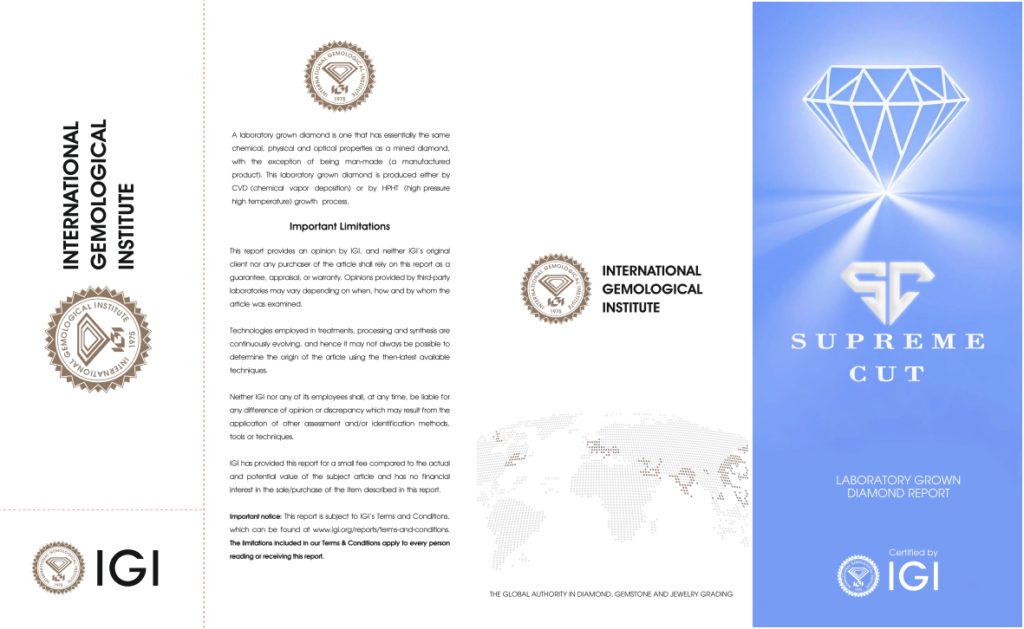
- It does not prove origin. Only a laboratory's identification can do that, using several tests.
- It does not change how the stone looks to the eye in normal conditions.
- It does not affect care. Clean and wear it like any diamond.
What to look for on a report
- The laboratory's statement that the stone is laboratory-grown, and the growth method if given.
- The grades and any treatment notes.
- The report number, which should match the girdle inscription if there is one.
Our advice Be wary of listings that use "Type IIa" as a selling point, as if it were a grade.
It depends Some buyers like the idea of a very pure stone, and for them the type is an interesting fact. For most people it should not decide the purchase.
Uncertain We cannot tell from a type alone how a particular stone will look or how a laboratory would classify it.
Related reading: CVD vs HPHT Lab Diamonds: What the Difference Means for Buyers · What Are Lab Grown Diamonds? A Plain-English Explanation
Sources
- GIA 4Cs, Diamond types
- GIA Gems & Gemology (Summer 2024), update on laboratory-grown diamonds
- GIA, Laboratory-grown diamond reports
Fact = stated by the cited source. Our advice = editorial recommendation. Uncertain / it depends = limits of what can be said in general.
Other perspectives from the ZKZ team
Do not describe a lab-grown stone as "purer" or "better" because of its type. The type is a chemical classification, and the origin should be stated in plain words.
Choose on what you can see: colour, clarity, cut and sparkle in daylight. Type does not change those.
No special care is needed for type IIa or any other type. Warm water, mild soap and a soft brush are enough for everyday cleaning.
Have a different question? Ask our team, or browse more answers in Talk.
Related products
Related articles & topics
- What does "cultured diamond" mean, and is it the same as lab-grown?Talk
- How do I compare two silver diamond pendants with the same stone size?Talk
- What does fluorescence mean on a lab-grown diamond report?Talk
- What Does a Lab-Diamond Grading Report Show, and Is a Seller's Report Enough?Talk
- What should a lab-grown diamond disclosure look like on a product page?Talk
- Lab Diamond Necklace Lengths and LayeringGuide
- Caring for 925 Sterling Silver Jewelry with Lab Grown Diamond SettingsGuide
- Prong vs Bezel vs Halo Settings for Diamond EarringsGuide
- Lab Diamond Hoops and Drop Earrings: Styles and WeightGuide
- Wholesale Lab Diamond Jewelry: What Buyers Should VerifyGuide
Recommended
 What is the difference between GIA, IGI and in-house reports for lab-grown diamonds?Talk
 What bracelet size should I order if I have a small, medium or large wrist?Talk
 What are flat-back studs, and who needs them for cartilage or sleeping?TalkWhat jewelry suits an engagement-party or bridal-shower gift?Talk
 Can nickel-free silver jewelry still cause a reaction?Talk
 What are the black spots on my silver jewelry, and are they damage or tarnish?Talk