How should diamond weight be stated: decimal or fraction?
925 sterling silver jewellery, set with lab grown diamonds and made in our own Shenzhen workshop.
Talk · Compliance & disclosure
A seller lists a pendant as "1/2 ct diamond" and another as "0.50 ct". A buyer wants to know whether the two mean the same thing and how weight should be written in a listing.
 ZKZ Editorial TeamMain answer · Product & gemmology desk
A decimal weight such as "0.50 ct" should be accurate to the last decimal place, so it is the more exact statement. A fraction such as "1/2 ct" is allowed but, under the FTC Jewelry Guides, should come with a conspicuous note that the weight is not exact and a reasonable range for each fraction. So the two do not necessarily mean the same thing.
What the FTC Guides say
Fact A carat is a unit of weight equal to 200 milligrams, or one fifth of a gram, and a point is one hundredth of a carat. It is unfair or deceptive to misrepresent the weight of a diamond, and the word "point" or an abbreviation should be used only if the weight is also stated as decimal parts of a carat (16 CFR 23.18).
Fact If weight is stated in decimals, such as .47 carat, the figure should be accurate to the last decimal place. If only one decimal place is stated, such as .5 carat, the stated figure should be accurate to the second decimal place, so ".5 carat" could represent a weight between .495 and .504.
Fact If weight is stated as fractional parts of a carat, a conspicuous disclosure that the weight is not exact should be made in close proximity to the fraction, together with a reasonable range of weight for each fraction or the tolerance used. In catalogues, the disclosure should be on every page where fractions are used.
Uncertain The Guides apply in the US, and other countries have their own rules. They are guidance, and the full text and any updates are on the eCFR site.
What this means for a listing
- Best practice: use decimals to two places for single stones, such as "0.50 ct".
- If you use fractions, put the "not exact" note and the range next to the fraction, and not only in a footer.
- For several stones, say whether the number is the total carat weight and how many stones there are.
- Do not round up. A stone of 0.46 ct is not a "half carat" without a range.
Questions for a buyer
- Is the weight of the centre stone, or the total of all stones?
- Is it from a laboratory report or the seller's estimate?
- What range does "1/2 ct" cover?
Our advice Prefer a listing with a decimal weight and a report, and ask the seller if the fractional weight is a range.
It depends A fraction can be a convenient shorthand in ordinary speech. In a product listing, it should be backed by the exact number or a range.
Related reading: Lab Grown Diamond Certification: IGI, GIA and What to Check
Sources
- 16 CFR 23.18, FTC Jewelry Guides: misrepresentation of weight and "total weight"
- GIA 4Cs, Nine things about diamond carat weight
Fact = stated by the cited source. Our advice = editorial recommendation. Uncertain / it depends = limits of what can be said in general.
Other perspectives from the ZKZ team
Check every listing for fractions and "point" wording. If you use them, add the not-exact note and the range beside the figure, and keep the numbers you rely on.
Ask suppliers for weights to two decimal places from a balance or report, and not as rounded fractions, so your listing can be exact.
Compare stones by decimal weight and by size in millimetres. Two stones of the same weight can look different in size depending on the cut.
Have a different question? Ask our team, or browse more answers in Talk.
Related products
Related articles & topics
- What should a lab-grown diamond disclosure look like on a product page?Talk
- How do I price lab-diamond silver jewelry for retail from a factory quote?Talk
- Is silver diamond jewelry a good 25th (silver) anniversary gift?Talk
- How often should prongs on a lab-diamond ring be checked?Talk
- What clarity level is enough for a lab diamond under 0.5 ct?Talk
- Silver Pendant Chains: Matching Weight to Pendant SizeGuide
- Cleaning Lab Diamond Earrings Without Damaging the SettingGuide
- How to Choose a Lab Diamond: The 4Cs Without the JargonGuide
- Lab Grown Diamond Earrings in Silver: Buying ChecklistGuide
- Men’s Lab Grown Diamond Rings and BandsGuide
Recommended
 What is the difference between GIA, IGI and in-house reports for lab-grown diamonds?Talk
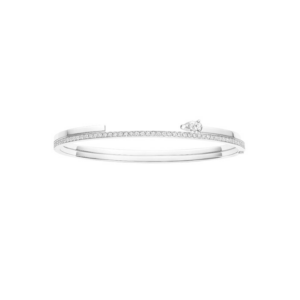 What bracelet size should I order if I have a small, medium or large wrist?Talk
 What are flat-back studs, and who needs them for cartilage or sleeping?TalkWhat jewelry suits an engagement-party or bridal-shower gift?Talk
 Can nickel-free silver jewelry still cause a reaction?Talk
 What are the black spots on my silver jewelry, and are they damage or tarnish?Talk