Lab Diamond Bracelets for Everyday Wear: Styles and Durability
925 sterling silver jewellery, set with lab grown diamonds and made in our own Shenzhen workshop.
Buyers usually assume the heaviest bracelet is the most durable one, and the assumption costs them. A light, well-built line on a properly rated clasp outlasts a heavier bracelet whose clasp was chosen for appearance and whose end links take the entire load. The variables that decide whether a bracelet survives years of daily wear are construction, closing mechanism, setting height and width — and none of them appear in the carat total that most buyers compare first.
Which bracelet survives everyday wear?
The one with the lowest setting height, the strongest closure and articulated links.
Everything a bracelet meets in a day — desks, keys, door handles, sleeves, seat belts — makes contact at the surface. Claws that protrude catch on fabric and bend; flush and bezel settings present nothing to catch. The closure takes repeated tension every time the wrist moves. The links decide whether movement spreads along the line or concentrates at two points.
Those four factors decide durability. A buyer specifying for daily wear should treat them as the specification and treat stone size as the variable that fills the remaining budget.
The four bracelet constructions
Each behaves differently on a wrist that moves all day.
| Construction | Structure | Daily-wear behaviour | Maintenance |
|---|---|---|---|
| Tennis line | Continuous articulated stones | Hangs well, but many settings to inspect | Clasp, end links, prongs |
| Chain with stations | Spaced stones on a chain | Most forgiving; few contact points | Chain stretch at the clasp |
| Bangle | Rigid loop, hinge or open ends | Wears at contact points, cannot snag easily | Hinge and any engraved surface |
| Charm or drop | Stones hanging from links | Movement and impact on each drop | Individual links and findings |
What breaks first on a bracelet
The same points every time, in the same order.
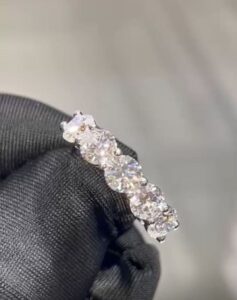
The clasp comes first, because it is opened and closed more often than anything else on the piece and because it takes the full tension of the line when the wrist moves. The end links come second, since they carry the load that the clasp releases. The third is the setting: on a tennis line, prongs are the only part that protrudes, and a bent claw eventually releases a stone.
Almost nothing else fails. Bracelet bands and stones are not the problem; the moving parts are.
Clasp class against weight
The closure has to be rated for the line, not chosen to match the metal.
A box clasp with a figure-eight safety is the conventional closure for a continuous line because it carries load across a broad internal tongue and closes inside the line. A lobster clasp is adequate for a light chain bracelet and is a liability on a heavy line. A toggle is easy to operate and easy to lose. Whatever the mechanism, a secondary safety should be present and operable without a tool.
The tennis bracelet buying guide covers how the closure interacts with the whole piece, and the notes on tennis bracelet fit cover how line length changes the load on it.
Setting height and the everyday surface
Lower settings are not a compromise for daily wear; they are the correct specification.
A tall basket setting exposes more of the stone and catches on more things. A low setting, a bezel or a flush-set sequence presents a surface closer to flat, so the bracelet slides over fabric and skin rather than catching. On a piece that is handled more than any other, that difference accumulates.
Where the design allows a choice, the daily-wear version of any bracelet is the one with the lower setting, even at the cost of some apparent size.
Metals and finishes
Metal affects how often the piece needs attention, not whether it can be worn.
White gold is the standard for high stone counts and needs re-plating at the contact points. Yellow and rose gold do not tarnish and hide fine scratches better. Platinum holds prongs longest and is the heaviest. Sterling silver is the accessible option and works well for lighter stones and station designs, though silver prongs in a continuously worn line need inspection more often than gold ones.
Finish matters as much as metal on a bracelet: a matte or brushed finish hides the fine scratches that a high polish shows first, which is why satin finishes are common on pieces designed for daily wear.
Stone size, count and width
Smaller stones across a line usually wear better than fewer large ones.
A line of many small stones has more settings to inspect but distributes weight more evenly and sits lower against the wrist. A bracelet built with fewer, larger stones carries more weight at each setting and needs a stronger clasp. On an everyday piece, the practical range is small to moderate stones in a low setting on a band width that suits the wrist rather than the photograph.
Total carat weight is a consequence of length, stone size and count. Ask for all three rather than the total alone.
Fit for continuous wear
A bracelet worn every day should sit closer than one worn occasionally.
A slight drape is comfortable and looks correct, but excess length lets the bracelet rotate until the clasp reaches the top of the wrist, where it catches on everything. Measure over the wrist bone, and check the length against a bracelet that already wears well. Because a continuous line cannot be lengthened later without matching stones, this is an order-stage decision.
Care that matches daily use
Three habits, and one that matters most.
Take the bracelet off for anything that involves impact or chemicals, including sport, cleaning and swimming. Wipe it after wear to remove skin oils before they harden in the settings. Store it flat rather than coiled, so the links keep their articulation. Then the fourth, which matters most: check the clasp and the end links monthly, because those are the components that decide whether the bracelet stays on the wrist.
At our end, bracelets are checked for clasp engagement, link articulation and setting security before packing, since those are the three points that produce returns.
Buying checklist
Seven lines to fix before ordering.
Construction type. Bracelet length and intended fit. Stone size range and count. Setting height and type. Clasp class and safety type. Metal, finish and whether it is plated. And the inspection interval the metal and wear pattern imply.
With those seven agreed, a durable everyday bracelet is a predictable purchase rather than a matter of luck.
FAQ
Can you wear a diamond bracelet every day?
Yes, provided the construction suits it. A low or bezel setting, a clasp rated for the weight of the line, articulated links and a length that keeps the bracelet from rotating are what make daily wear practical. A high-claw setting on a light clasp is the combination that fails first.
What is the best everyday diamond bracelet?
For most wearers, a station or lightly set bracelet in a low setting is the most forgiving, because it has fewer contact points and nothing protruding to catch. A tennis line works for daily wear too, as long as the clasp class matches the weight and the prongs are checked regularly.
How fragile is a tennis bracelet?
The line itself is robust; the failure points are the clasp, the two end links and the prongs. A tennis bracelet with a box clasp and figure-eight safety, articulated end links and uniform prongs lasts for years of daily wear. Most losses trace back to a clasp that was too light for the weight of the line.
Should a bracelet be worn loose or snug?
Slightly loose for occasional wear, closer for daily wear. A bracelet with too much slack rotates until the clasp sits on top of the wrist, where it catches and eventually opens. Measure over the wrist bone and check the length against a bracelet that already fits well.
Sources and further reading
- GIA 4Cs — grading factors for matched stone runs
- GIA Report Check — verifying stone documentation
- The Silver Institute — silver alloys used in bracelet construction
- ASTM B700 — electrodeposited silver coating specification
- Assay Office — precious metal standards and hallmarking
- CIBJO Blue Books — jewellery terminology
Next step: Tell us how often the bracelet will be worn and what it will be exposed to, and we will specify the construction, setting height, clasp class and length that suit the wear pattern, then sample it before production. Ready-stock bracelets and OEM programmes are both available. Contact vinico@zkzdiamonds.com or WhatsApp +86 135 3037 8229.
{“@context”:”https://schema.org”,”@type”:”FAQPage”,”mainEntity”:[{“@type”:”Question”,”name”:”Can you wear a diamond bracelet every day?”,”acceptedAnswer”:{“@type”:”Answer”,”text”:”Yes, provided the construction suits it. A low or bezel setting, a clasp rated for the weight of the line, articulated links and a length that keeps the bracelet from rotating are what make daily wear practical. A high-claw setting on a light clasp is the combination that fails first.”}},{“@type”:”Question”,”name”:”What is the best everyday diamond bracelet?”,”acceptedAnswer”:{“@type”:”Answer”,”text”:”For most wearers, a station or lightly set bracelet in a low setting is the most forgiving, because it has fewer contact points and nothing protruding to catch. A tennis line works for daily wear too, as long as the clasp class matches the weight and the prongs are checked regularly.”}},{“@type”:”Question”,”name”:”How fragile is a tennis bracelet?”,”acceptedAnswer”:{“@type”:”Answer”,”text”:”The line itself is robust; the failure points are the clasp, the two end links and the prongs. A tennis bracelet with a box clasp and figure-eight safety, articulated end links and uniform prongs lasts for years of daily wear. Most losses trace back to a clasp that was too light for the weight of the line.”}},{“@type”:”Question”,”name”:”Should a bracelet be worn loose or snug?”,”acceptedAnswer”:{“@type”:”Answer”,”text”:”Slightly loose for occasional wear, closer for daily wear. A bracelet with too much slack rotates until the clasp sits on top of the wrist, where it catches and eventually opens. Measure over the wrist bone and check the length against a bracelet that already fits well.”}}]}
Part of our sterling silver bracelets guide.
Recommended
 Does a lab-grown diamond need Kimberley Process paperwork when shipped?Lab Grown Diamond Guide
 Is it better to buy a loose lab-grown diamond and set it, or buy finished jewelry?Lab Grown Diamond Guide
 Is Lab Grown Diamond Jewelry a Good Investment?Buying Guides
 What is a “hearts and arrows” cut, and is it available in lab-grown stones?Lab Grown DiamondsDoes a lab-grown diamond need an appraisal, and what does one include?Lab Grown Diamonds
 Custom Lab Grown Diamond Jewelry: A Step-by-Step GuideCustom Jewelry