Diamond Stud Size Guide: 0.5 ct to 3 ct on the Ear
925 sterling silver jewellery, set with lab grown diamonds and made in our own Shenzhen workshop.
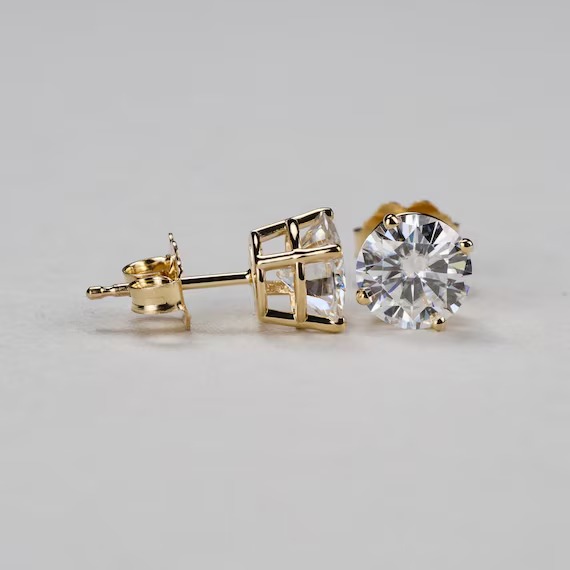
Two buyers order studs of the same weight and one is delighted while the other sends them back. The difference is rarely the stone. It is the ear. Studs are read as a proportion of the lobe, and the same diamond that looks generous on one ear looks modest on another, because the lobe differs in size and the setting differs in height. Sizing studs means working in millimetres against the specific ear, not choosing a carat weight from a table.
Last updated:
How big is a 1 carat stud?
Approximately 6.5 mm across for a well-proportioned round stone.
Carat is a weight, not a distance, so the conversion depends on cut proportions and on the cut type. What follows is the working range for round brilliants with conventional proportions: a 0.5 ct stone is about 5.2 mm across, 0.75 ct about 5.9 mm, 1.0 ct about 6.5 mm, 1.5 ct about 7.4 mm, 2.0 ct about 8.1 mm and 3.0 ct about 9.3 mm.
Two consequences follow. First, the diameter grows more slowly than the weight, so doubling the carat weight does not double the size. Second, a shallow-cut stone of a given weight can measure slightly wider than a well-proportioned one, which is a size gain bought with light performance.
The size table, and what each size does
Weight, diameter and the role each size tends to play.
| Weight per stone | Approx. diameter | Reads as | Typical use |
|---|---|---|---|
| 0.25 ct | 4.1 mm | Subtle, second hole or stacking | Multiple piercings, gifts |
| 0.50 ct | 5.2 mm | Present but understated | Everyday, first fine studs |
| 0.75 ct | 5.9 mm | Clearly visible, still light | Everyday upgrade |
| 1.00 ct | 6.5 mm | The familiar reference size | Everyday to occasional |
| 1.50 ct | 7.4 mm | Noticeable across a room | Occasions, evening wear |
| 2.00 ct | 8.1 mm | Substantial, needs a setting that carries it | Statement pieces |
| 3.00 ct | 9.3 mm | Large on most lobes | Formal and bridal |
Total carat weight versus per-stone weight
Studs are sold as a pair, and the two numbers differ by a factor of two.
A listing described as 1.00 ct total means two 0.50 ct stones, which measure about 5.2 mm each. A listing described as 1.00 ct per stone means two stones of 6.5 mm, with a total weight of 2.00 ct. The difference in appearance is large and the difference in price is larger. This single ambiguity accounts for a significant share of disappointing online purchases.
Always ask for per-stone weight and diameter in millimetres, and treat the diameter as the number that describes what you will see.
How the ear changes the reading
The same stone looks different on different lobes, and this is not a matter of taste.
A stud is judged against the lobe it sits on. On a small, attached lobe, a 1.00 ct stone covers a substantial share of the visible ear and reads as large. On a long, detached lobe, the same stone occupies a smaller proportion and reads as moderate. The position of the piercing matters as well: a higher piercing leaves more lobe below the stone and makes the stone look better balanced.
This is why trying a pair — or at least measuring the lobe and the piercing position — is more useful than comparing photographs of stones.
How settings change apparent size
The setting can add a millimetre or more of visible diameter.
A bezel surrounds the stone with a rim of metal, which enlarges the visible circle for the same stone. A halo adds a ring of small stones around the centre, increasing apparent size considerably without increasing the centre stone’s weight. A four-prong setting shows more of the stone itself and adds almost nothing, which makes the stone look its true size and no larger.
A tall setting also changes perception: the stone sits further from the ear, catches more light and photographs larger, at the cost of comfort and of snagging on clothing.
Sizes for daily wear versus occasions
Daily wear rewards restraint; occasions reward presence.
For continuous wear, weight is the limiting factor rather than size, because a heavy stone pulls on the lobe and becomes noticeable by evening. A 0.50 to 1.00 ct per-stone pair in a low setting is the range most wearers find comfortable all day. Above that, a low bezel setting helps, but the mass is still there.
For occasional wear, larger stones in tall settings or halos are practical, because the ear is not carrying them for twelve hours.
Matching tolerance across the pair
On a pair worn side by side, matching is part of the size specification.
Both stones should match in diameter as well as in colour, because a visible difference in size between two earrings is noticed immediately at conversation distance. The tolerance should be stated numerically — for example within a defined weight percentage and a defined colour band — rather than described as “matched”.
Colour matching matters more on studs than on almost any other piece, since the two stones sit within a few centimetres of each other in the same light.
Checking the size before you commit
Four steps that take ten minutes and avoid most exchanges.
One: measure the lobe height and width, and note where the piercing sits. Two: cut circles of paper to the diameters in the table and hold them against the ear in a mirror at conversation distance, not up close. Three: decide the setting next, because a bezel changes the apparent size by roughly the width of its rim. Four: confirm whether the price quoted is per stone or per pair.
Testing with paper circles is crude and unusually effective. It is the only check that puts the size where it will actually be seen. Where the pair will be set in silver rather than gold, the silver lab grown diamond checklist adds the metal-specific points to confirm at the same time.
What to verify on the order
Five lines to fix in writing.
Per-stone weight and diameter in millimetres. Colour and clarity grade, and the matching tolerance across the pair. Setting type and height. Metal and post diameter. Back type. With those five lines agreed, a size comparison between two suppliers becomes meaningful, and the pair that arrives is the pair that was specified.
FAQ
What carat diamond studs look best?
There is no universal answer, because a stud is read as a proportion of the lobe. On a smaller lobe, 0.50 to 1.00 ct per stone is often enough; on a larger lobe, a step up may be needed for the same effect. Choose size by testing against the ear rather than from a table.
How big is a 1 carat stud in millimetres?
About 6.5 mm across for a round brilliant with conventional proportions. The exact figure depends on cut proportions. A 0.5 ct stone is roughly 5.2 mm and a 2.0 ct stone roughly 8.1 mm, so the diameter grows much more slowly than the weight.
Does 1 carat total mean 1 carat each?
No. For earrings, a 1.00 ct total figure usually means two stones of about 0.50 ct each, measuring roughly 5.2 mm. Per-stone weight is the figure that describes what you will see, so ask for per-stone weight and diameter rather than accepting a total.
Do bezel settings make studs look bigger?
Yes. A bezel adds a rim of metal around the stone, so the visible circle is larger than the stone itself. A halo increases apparent size further by surrounding the centre stone with small stones. A four-prong setting adds almost nothing and shows the stone at its true diameter.
Sources and further reading
- GIA 4Cs — carat weight and what it does and does not tell you
- GIA — diamond grading overview
- GIA — grading scales used to match a pair
- International Gemological Institute — grading and reports
- CIBJO Blue Books — terminology for weight and origin
- International Gem Society — setting and measurement reference
Next step: Send the diameter you are aiming for and the metal you prefer, and we will match a pair to a stated tolerance and confirm the setting height before production so the size you approve is the size that arrives. Ready-stock pairs and OEM programmes are both available. Contact vinico@zkzdiamonds.com or WhatsApp +86 135 3037 8229.
Part of our 925 sterling silver jewelry guide.
Recommended
 Does a lab-grown diamond need Kimberley Process paperwork when shipped?Lab Grown Diamond Guide
 Is it better to buy a loose lab-grown diamond and set it, or buy finished jewelry?Lab Grown Diamond Guide
 Is Lab Grown Diamond Jewelry a Good Investment?Buying Guides
 How do I choose lightweight earrings that do not pull on the earlobe?Lab Grown Diamond Earrings
 What is a “hearts and arrows” cut, and is it available in lab-grown stones?Lab Grown Diamonds
 What are lab-diamond studs in a martini, basket or screw setting, and which is secure?Lab Grown Diamond Earrings