Lab Grown Diamond Stud Earrings: Sizes, Settings and Price
925 sterling silver jewellery, set with lab grown diamonds and made in our own Shenzhen workshop.
Stud earrings are the most worn piece of fine jewellery most people own. They go on in the morning and stay on, which means the decisions that matter are not the ones that appear on a certificate. They are the setting that holds the stone, the back that keeps it in place, and the weight that decides whether the ear is comfortable by evening. Size and price come after those three, and each of the choices along the way narrows the ones that follow.
Last updated:
What size lab grown diamond studs should you buy?
Start from the ear, not from the carat number.
A stud is judged on the ear from a normal conversation distance, and what the eye reads is the diameter of the stone as a proportion of the lobe. On a smaller lobe, a moderate stone can read as large; on a larger lobe, the same stone disappears. Because lab grown supply makes larger sizes accessible at a lower price, the temptation is to go bigger than the ear supports, and the result looks heavy rather than generous.
A practical starting point is to decide whether the earrings are for daily wear or for occasions, then choose the size that reads as deliberate at conversation distance rather than the largest the budget allows.
Prong, bezel or halo
The setting changes visual size, protection and snagging, and it is the decision most buyers under-think.
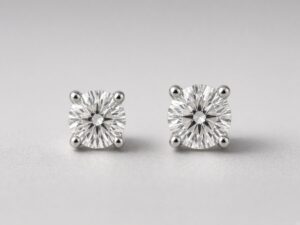
A four-prong setting shows the most stone and lets light through from the side, at the cost of exposed claws that catch on hair and scarves. A bezel encloses the girdle in metal, which protects the stone and sits flatter against the ear, and it makes a given stone read slightly larger because the metal adds a rim. A halo surrounds the centre stone with smaller stones, which increases apparent size considerably and increases cleaning and snagging with it.
For daily wear, bezel or a low four-prong is the practical choice. For an occasional piece, halo gives the most visual presence per carat.
What the price is actually made of
Stones by weight, metal, setting labour and the backs.
Studs are bought as a matched pair, so the price covers two stones rather than one, and matching the pair is part of the cost. The metal weight is small but not negligible, particularly in gold. Setting labour is modest per stone, and the backs are usually included. The part buyers most often overlook is matching: two stones of the same grade can differ slightly in colour or in how they face, and on a pair worn side by side that difference is visible.
Ask whether the pair is matched for colour and size, and how that matching is controlled, because it is a specification rather than a courtesy.
Metals and sensitive ears
The post touches the skin directly, so metal choice matters more here than on any other piece.
Sterling silver, 14K and 18K gold and platinum are all used for posts. Nickel, which is a common alloying element in some white golds and in base metals, is the usual cause of irritation, and nickel-free specifications exist for exactly that reason. For anyone with a history of reaction, a nickel-free gold alloy or a titanium post solves the problem at negligible cost, and a coated base metal does not, because coatings wear through at the point of contact.
The lab grown diamond earrings in silver checklist covers the extra points that apply when the metal is sterling silver.
Backs: the part that decides whether you keep the earring
Four common types, each with a different failure mode.
| Back type | How it holds | Best for | Failure mode |
|---|---|---|---|
| Butterfly | Friction on the post | Light stones, occasional wear | Loosens as the friction wears |
| Screw | Threaded post and back | Sleeping in them, valuable stones | Slow to fit; threads clog with product |
| Push with silicone | Silicone collar grips the post | Comfort, quick changes | Silicone perishes and needs replacing |
| Locking (La Pousette) | Mechanical catch on the post | High-value stones worn daily | Higher cost; needs careful fitting |
For a stone worth protecting, a screw or locking back is the difference between a small inconvenience and a lost stone. The earring back types guide goes further into which style suits which wear pattern.
Comfort and daily wear
Weight distribution, post length and setting height decide whether the earache arrives at six in the evening.
A heavy stone on a thin post pulls the lobe downward, and the sensation is not proportional to weight but to how far the mass sits from the ear. A low setting places the stone closer to the lobe and feels lighter than a tall one holding the same stone. Post length matters too: too long and the earring flops forward, too short and the back presses into the lobe.
For daily wear, a lower setting with a well-fitted post is more comfortable than a larger stone in a tall basket setting, even when the larger stone weighs more.
Choosing between them: the decision order
Work through five questions and the specification writes itself.
One: daily wear or occasions. Two: the size that reads correctly on this lobe. Three: prong, bezel or halo, decided by wear rather than by preference. Four: metal, with nickel sensitivity checked before anything else. Five: back type, matched to the value of the stone and how often the earrings will be left in.
Once those five are settled, the stone grades fill in the remaining budget rather than driving the design.
What to check before ordering
Four points that prevent the returns most often seen on studs.
Confirm that both stones are matched for colour and size, and ask for the tolerance in writing. Confirm the post diameter and length, since these decide comfort and how the piece sits. Confirm the back type and whether the backs are the same metal as the earrings. And confirm the setting type, because a photograph of a prong setting and a delivered bezel are different products even when the carat weight matches.
For a repeat order, keep the sample pair. Matching the second order to the first is much easier against a physical reference than against a specification sheet.
FAQ
What size lab diamond studs should I buy?
Choose the size that reads as deliberate on the ear at conversation distance rather than the largest your budget allows. Lobe size, not carat weight, decides how large a stone looks. Setting type changes apparent size too, so a smaller stone in a bezel or halo can read larger than a bigger stone in a low prong setting.
How much are lab diamond stud earrings?
The price is built from a matched pair of stones, the metal, the setting labour and the backs. Because studs are bought as a pair, matching is a real part of the cost, and it is the line most often left out of a comparison. Ask what the pair is matched for and to what tolerance.
Are lab diamond studs good for everyday wear?
Yes, and they are among the best pieces for it, provided the setting and back suit daily use. A bezel or low four-prong setting snags less than a tall basket, and a screw or locking back is safer than a friction butterfly on a stone worth protecting.
Which metal is best for sensitive ears?
A nickel-free alloy. Sterling silver, 14K and 18K gold, platinum and titanium posts are all used for sensitive ears; the common irritant is nickel, which appears in some white gold alloys and in base metals. A coating over a base metal does not solve it, because coatings wear through exactly where the post contacts the skin.
Sources and further reading
- GIA 4Cs — how pairs are assessed and matched
- GIA — diamond grading overview
- International Gemological Institute — grading and reports
- Assay Office — precious metal standards for gold, silver and platinum
- CIBJO Blue Books — jewellery and diamond terminology
- International Gem Society — setting and earring construction reference
Next step: Tell us whether the earrings are for daily wear or occasions, the metal you prefer and any sensitivity to nickel, and we will specify the setting, post and back that suit the wear pattern, then quote a matched pair. Ready-stock studs ship in days and OEM programmes are quoted per parcel. Contact vinico@zkzdiamonds.com or WhatsApp +86 135 3037 8229.
Part of our sterling silver earrings guide.
Recommended
 Does a lab-grown diamond need Kimberley Process paperwork when shipped?Lab Grown Diamond Guide
 Is it better to buy a loose lab-grown diamond and set it, or buy finished jewelry?Lab Grown Diamond Guide
 Is Lab Grown Diamond Jewelry a Good Investment?Buying Guides
 How do I choose lightweight earrings that do not pull on the earlobe?Lab Grown Diamond Earrings
 What is a “hearts and arrows” cut, and is it available in lab-grown stones?Lab Grown Diamonds
 What are lab-diamond studs in a martini, basket or screw setting, and which is secure?Lab Grown Diamond Earrings